
Recently, I discovered DNS4EU, the European DNS initiative, and I was immediately interested. Finally, there is a serious effort in Europe to provide a privacy-respecting, sovereign alternative to global DNS services like Google Public DNS or Cloudflare. For anyone who cares about digital sovereignty, data protection, and online privacy, this is a project worth following.
What DNS4EU Is About
DNS4EU is a European Union initiative providing public DNS resolvers operated entirely within the EU. Its main goal is to offer citizens, companies, and public institutions a secure, privacy‑respecting, and independent alternative to global DNS providers. The service is designed to ensure that European Internet traffic stays under European rules, in line with GDPR and other privacy standards.
The project is supported by a pan-European consortium of cybersecurity organisations, academic partners, and national CERTs. Countries involved include Germany, Czech Republic, Belgium, Hungary, Italy, Poland, Romania, and others, reflecting a broad collaboration across Europe. The network also benefits from threat intelligence sharing, improving security for all users.
The DNS4EU website (joindns4.eu) is well structured, with clear guidance for individual users and businesses, explaining resolver types and setup options. DNS4EU is voluntary, focused on security and privacy, and not a censorship tool.
Different Resolver Types
DNS4EU currently provides multiple resolver options, allowing users to choose the right level of protection.
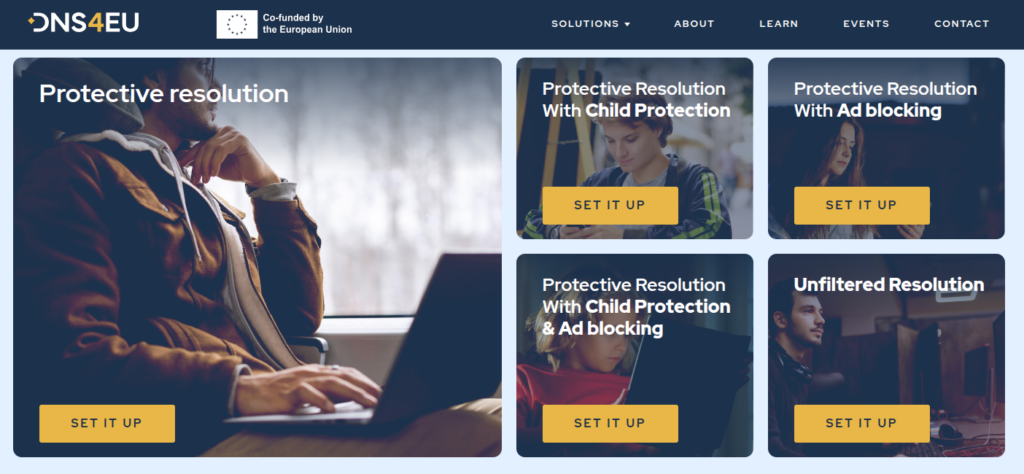
DNS4EU offers several resolver types, each designed with specific protection goals. The table below summarizes the core functionality of each option, helping users quickly understand the differences and choose the one that fits their needs.
| Resolver Type | Malicious/Fraud Protection | Child Protection | Ad Blocking |
|---|---|---|---|
| Unfiltered Resolution | – | – | – |
| Protective Resolution | ✓ | – | – |
| Protective Resolution With Child Protection | ✓ | ✓ | – |
| Protective Resolution With Ad Blocking | ✓ | – | ✓ |
| Protective Resolution With Child & Ad Blocking | ✓ | ✓ | ✓ |
The supported resolution technologies include
- Plain DNS over IPv4 and IPv6 for standard network and router configurations
- DNS over HTTPS (DoH) for encrypted, application-level DNS resolution
- DNS over TLS (DoT) for encrypted, network-level DNS communication
This structure is clear and allows users to balance privacy, protection, and convenience. In addition, DNS4EU provides clear and well-documented setup instructions, making it straightforward to choose the appropriate resolution technology based on the device, operating system, and security requirements.
Digital Sovereignty in Europe
Digital sovereignty is more than a slogan. Most global DNS traffic is handled by US-based providers, which means European users are sending sensitive metadata abroad. DNS4EU ensures that queries remain within Europe and are subject to European law. This is an important step toward true digital self-determination.
Strategy: Primary Resolver and Fallbacks
When I set up DNS4EU, my strategy was simple:
- Primary: DNS4EU Unfiltered – maximum privacy, no false positives.
# DNS4EU Unfiltered Resolution
https://unfiltered.joindns4.eu/dns-query- Fallbacks: Only used if the primary is unavailable, avoiding reliance on Google or Cloudflare.
# Deutsche Telekom
https://dns.telekom.de/dns-query
# Google
https://dns.google/dns-query
# Cloudflare
https://cloudflare-dns.com/dns-query
One important point to consider is the separation of your carrier and DNS resolution. Even though your ISP assigns your IP address, using an external DNS service like DNS4EU can help limit the visibility of the domains you query. With DNS-over-HTTPS (DoH), all requests are encrypted, providing an additional layer of privacy.
In Germany, providers such as Deutsche Telekom are generally trusted and adhere to principles like data minimization and strong security standards. Nevertheless, for extra risk reduction and enhanced digital sovereignty, it can be a good idea to use a privacy-focused DNS service that is independent of your carrier. This approach balances everyday trust in your ISP with the benefits of EU-based privacy and control over your DNS traffic.
Experience So Far
In practice, DNS4EU Unfiltered resolves queries quickly and without interference. Protective or filtered resolvers can be used optionally, but for normal browsing I prefer no filtering. Fallbacks are rarely needed, but they provide safety in case of temporary outages.
Overall, it is a stable, privacy-focused solution that feels like a meaningful step toward European digital independence.
Conclusion: Why You Should Use DNS4EU
If you value digital sovereignty, privacy, and control over your data, I strongly recommend starting to use DNS4EU today. Prefer EU-based resolvers as primary, keep fast fallbacks if necessary, and consider carrier-DNS separation. Every query routed through DNS4EU is a small but tangible contribution to a more secure and independent European Internet.
DNS4EU is not just another DNS service. It is Europe taking control of its digital infrastructure, one query at a time.