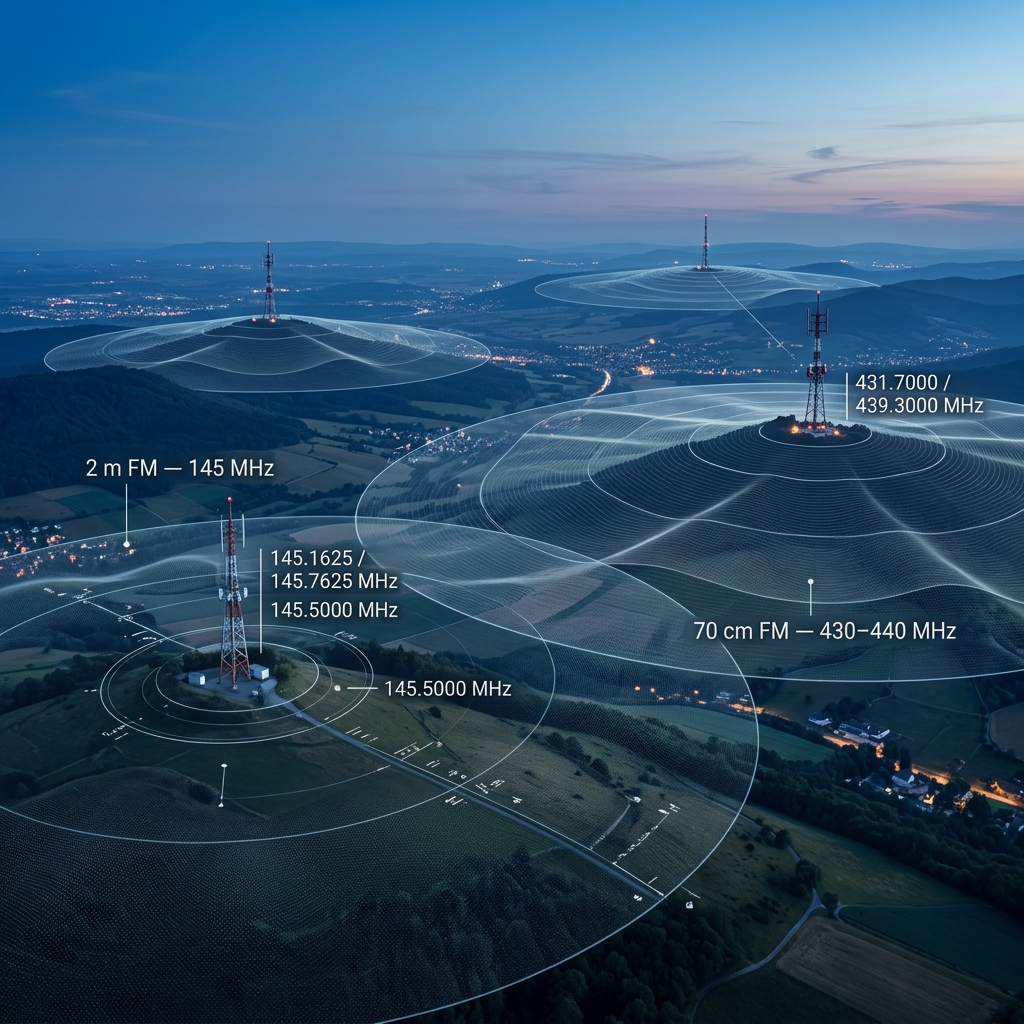
DMR repeaters extend the range of digital amateur radio communications and connect local radio coverage with wider networks. Unlike an analog FM repeater, a DMR repeater uses time slots, color codes and talkgroups to organize multiple conversations on the same radio frequency.
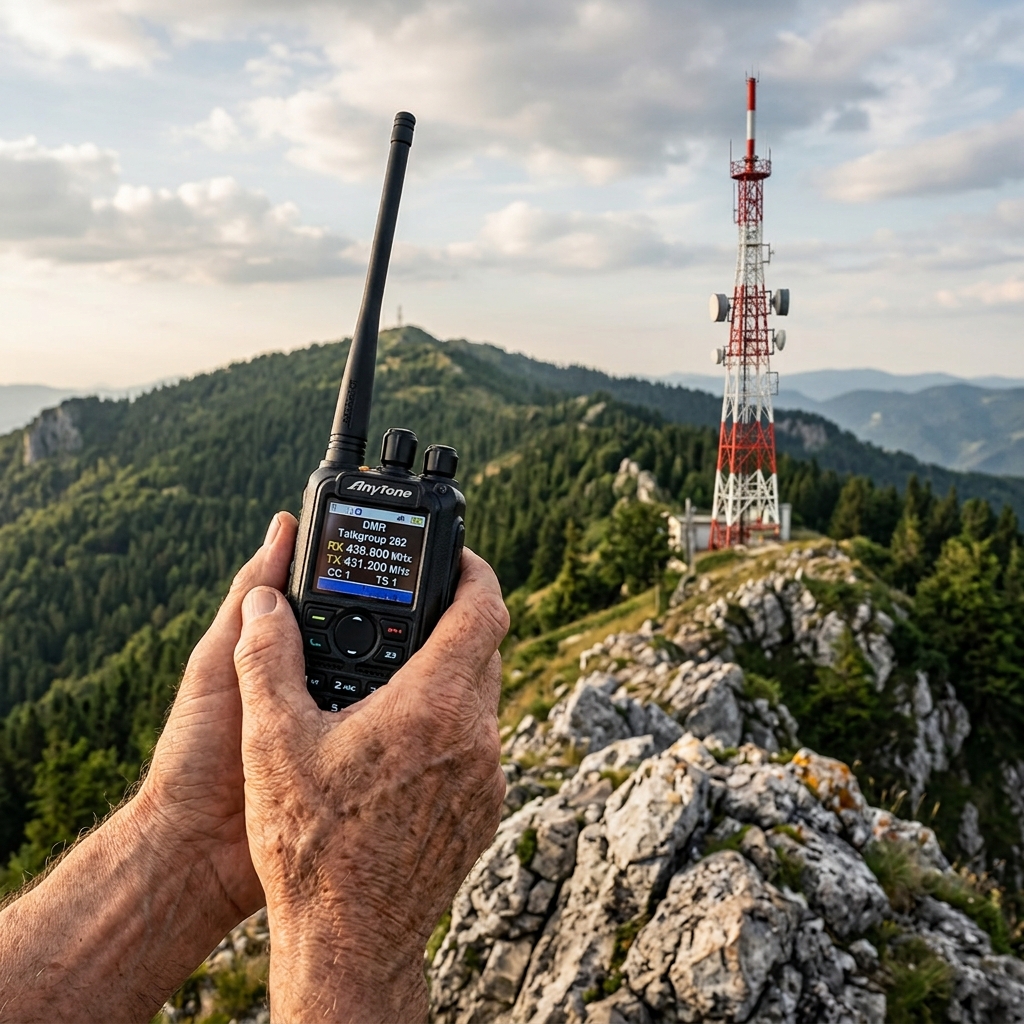
This article explains the basic principles of DMR repeaters, the parameters required for operation and how to select the appropriate talkgroup for a QSO.
What Is a DMR Repeater?
A DMR repeater receives a digital radio signal on one frequency and retransmits it on another frequency. This allows handheld and mobile radios to communicate over considerably greater distances than would normally be possible with direct radio-to-radio communication.
A typical DMR repeater configuration consists of:
| Parameter | Purpose |
|---|---|
| RX Frequency | Frequency used by the radio to listen to the repeater |
| TX Frequency | Frequency used by the radio to transmit to the repeater |
| Offset | Difference between repeater input and output |
| Color Code | Digital access code used by the repeater |
| Timeslot | One of two independent DMR transmission paths |
| Talkgroup | Defines which group of stations receives the transmission |
| Network | Network to which the repeater is connected |
For the operator, the most important concept is that the radio listens on the repeater’s output frequency and transmits on its input frequency.
Example: DMR Repeaters in the Rhine-Main Area
The Rhine-Main area provides a useful example of how DMR repeaters can differ in frequency, network and configuration. The following examples are intended to illustrate the parameters involved, rather than provide a complete or permanent repeater directory.
| Callsign | Output (TX) | Input (RX) | Offset | CC | Network | QTH |
|---|---|---|---|---|---|---|
| DB0FDA | 438.5000 | 430.9000 | -7.600 | 1 | BrandMeister | Darmstadt |
| DB0RID | 438.2125 | 430.6125 | -7.600 | 1 | BrandMeister | Riedstadt |
| DM0GG | 438.2250 | 430.6250 | -7.600 | 1 | BrandMeister | Groß-Gerau |
| DB0MW | 439.8000 | 430.4000 | -9.400 | 1 | BrandMeister | Mörfelden-Walldorf |
| DB0CIX | 438.8375 | 431.2375 | -7.600 | 1 | BrandMeister | Frankfurt am Main |
| DB0MOT | 438.2375 | 430.6375 | -7.600 | 1 | BrandMeister | Kleiner Feldberg |
| DB0IDS | 438.4125 | 430.8125 | -7.600 | 1 | BrandMeister | Idstein |
| DB0VA | 438.1875 | 430.5875 | -7.600 | 1 | BrandMeister | Hohe Wurzel |
| DB0IUK | 438.3375 | 430.7375 | -7.600 | 1 | BrandMeister | Heppenheim |
https://www.spacesupport.de/digitalfunk/dmr-dmr/deutsche-brandmeister-repeater/?pdf=1288
The example shows why a DMR repeater cannot be identified by its frequency alone. Two repeaters may use different frequencies, different offsets or even different networks, while the same network may provide the same talkgroups across multiple repeaters.
For example, a DMR network may provide talkgroups for:
- local communication
- regional communication
- national communication
- international communication
- specific topics or special purposes
There can be many different talkgroups, and their availability depends on the DMR network and the configuration of the repeater.
DMR Uses Two Timeslots
DMR uses TDMA (Time Division Multiple Access). A single RF channel is divided into two alternating time slots.
This allows two separate conversations to take place on the same frequency at the same time.
| Timeslot | Use |
|---|---|
| TS1 | Conversation or talkgroup assigned to timeslot 1 |
| TS2 | Conversation or talkgroup assigned to timeslot 2 |
For example, a repeater may have a local or regional talkgroup on TS2 while a national talkgroup is available on TS1.
The timeslot is therefore an essential part of a DMR channel configuration. A correct frequency and Color Code are not sufficient if the wrong timeslot is selected.
Color Code
The DMR Color Code (CC) is comparable to a selective access code. It allows a radio to distinguish the intended repeater from other DMR signals using the same frequency.
Color Codes range from 0 to 15.
The Color Code is configured by the repeater operator and must match the value programmed into the radio.
For example:
| Parameter | Example |
|---|---|
| Frequency | 438.1875 MHz |
| Color Code | 1 |
| Timeslot | TS2 |
A wrong Color Code normally prevents the radio from accessing the repeater even when the frequency is correct.
What Is a Talkgroup?
A talkgroup (TG) is a virtual group of radio users within a DMR network. It determines who can hear your transmission and which other stations you can communicate with.
Unlike analog FM, where everyone using the same repeater channel can normally hear the transmission, DMR allows the network to separate users into different talkgroups.
DMR repeaters can be connected to different networks. The network determines how repeaters exchange traffic and which talkgroups are available.
Examples include:
- BrandMeister
- DMRplus
- Other regional, national or private DMR networks
The same talkgroup number can have a different role or availability depending on the network. For this reason, repeater information should always be checked against the current configuration of the repeater and network.
Talkgroup Examples
The following are examples of talkgroups that can be encountered on DMR repeaters in Germany and Europe:
| Talkgroup | Name | Typical use |
|---|---|---|
| TG 1 | Local | Local communication |
| TG 8 | Regional | Regional communication |
| TG 9 | Local | Local communication |
| TG 92 | Europe | Communication across Europe |
| TG 262 | Germany | National communication within Germany |
| TG 2625 | Rheinland-Pfalz / Saarland | Regional communication |
| TG 2626 | Hessen | Regional communication |
| TG 26269 | Hessen / Rheinland-Pfalz multimode | Regional communication |
| TG 263113 | (Un)Wetter Netz | Weather-related communication |
| TG 910 | German | German-language communication |
| TG 91 | World-wide | World wide communication |
These are examples, not universal DMR standards. The exact talkgroups available to you depend on the DMR network and the repeater you are using.
Talkgroups and Timeslots
DMR uses two independent TDMA timeslots:
- TS1 – Timeslot 1
- TS2 – Timeslot 2
A talkgroup is normally assigned to a specific timeslot on a particular repeater.
For example, a repeater could be configured like this:
| Timeslot | Talkgroup | Purpose |
|---|---|---|
| TS1 | TG 262 | Germany |
| TS2 | TG 26269 | Hessen / Rheinland-Pfalz |
If you want to use TG 26269 on this repeater, your radio should therefore use TS2.
The important point is:
The timeslot is not derived from the frequency. It is part of the repeater’s DMR configuration.
You therefore cannot determine the correct timeslot simply by looking at the repeater frequency.
The same talkgroup can also be assigned to a different timeslot on another repeater. Always check the current configuration of the repeater or the information provided by its operator.
Static and Dynamic Talkgroups
Talkgroups can be available in different ways.
A static talkgroup is permanently configured on a repeater. Traffic for this talkgroup is normally available without the user having to activate it.
A dynamic talkgroup can be activated temporarily, depending on the DMR network and repeater configuration. After activation, the repeater may carry traffic for that talkgroup for a limited period.
This is why a list of talkgroups that you have heard on a repeater should not automatically be treated as a list of permanently available talkgroups.
What Do I Need to Program?
To use a DMR talkgroup through a repeater, you normally need the complete channel configuration:
Frequency + Offset + Color Code + Timeslot + Talkgroup
The frequency and offset determine how your radio communicates with the repeater.
The Color Code identifies the DMR repeater system.
The Timeslot and Talkgroup determine which DMR communication path you are using.
For example:
438.1875 MHz + 430.5875 MHz + CC1 + TS2 + TG 2626
This could represent a channel for accessing the Hessen talkgroup through a particular repeater.
The exact combination always depends on the repeater and DMR network. This is why DMR channels cannot be programmed correctly from the frequency alone.
Example of a DMR Channel
A complete DMR channel combines the repeater parameters with a talkgroup.
For example:
| Parameter | Configuration |
|---|---|
| Repeater | DB0VA |
| RX Frequency | 438.1875 MHz |
| TX Frequency | 430.5875 MHz |
| Offset | -7.600 MHz |
| Color Code | 1 |
| Timeslot | TS2 |
| Talkgroup | 26269 |
| Contact Type | Group Call |
| Network | BrandMeister |
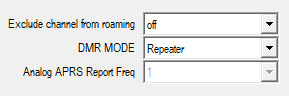
This represents one specific communication path through the repeater. Changing the talkgroup or timeslot creates a different communication configuration even though the RF frequencies remain unchanged.
How to Start a QSO Through a DMR Repeater
Before transmitting, listen to the selected talkgroup and make sure it is appropriate for the intended QSO.
A typical procedure is:
- Select the repeater channel.
- Check the Color Code.
- Select the required timeslot.
- Select the appropriate talkgroup.
- Listen before transmitting.
- Press PTT and make a short call.
- Release PTT and wait for a response.
- Continue the QSO using normal amateur radio operating practice.
For a local conversation, a local or regional talkgroup is usually more appropriate than a national or worldwide talkgroup.
Local Talkgroups
Local talkgroups are particularly useful for QSOs between stations within the coverage area of a repeater. For example, the Rhine-Main region includes repeaters where local, regional and national talkgroups can be used. The exact configuration varies between repeaters. A local talkgroup may be available on one repeater but not another, or it may be dynamically activated. Always check the repeater’s current configuration before assuming that a particular talkgroup is available.
Building a DMR Codeplug
When programming a DMR radio, the repeater and talkgroup information should be treated separately.
The repeater provides the RF parameters:
- RX frequency
- TX frequency
- Color Code
The communication profile adds:
- Timeslot
- Talkgroup
- Contact type
This makes it possible to create several channels for the same repeater.
For example:
| Channel | Repeater | TS | Talkgroup |
|---|---|---|---|
| DB0VA TG262 | DB0VA | TS1 | 262 Germany |
| DB0VA TG2626 | DB0VA | TS2 | 2626 Hessen |
| DB0VA TG26269 | DB0VA | TS2 | 26269 Hessen-RLP multimode |
| DB0VA Local | DB0VA | TS1/TS2 | 9 Local |
The exact channels that should be programmed depend on the current repeater configuration and the operating habits of the local amateur radio community.
Keeping Repeater Information Up to Date
DMR repeater configurations can change. Talkgroups may be added, removed or moved between timeslots, and network connections may change. For this reason, a codeplug should not be treated as a permanent source of truth.
Summary
DMR repeaters combine traditional repeater operation with digital networking.
The basic RF configuration consists of the RX frequency, TX frequency and Color Code. The digital communication path is then determined by the timeslot and talkgroup.
Once these concepts are understood, DMR repeaters become much easier to configure and use.
For practical radio programming, the next step is to translate this information into a DMR codeplug with the appropriate digital contacts, channels and zones.