The 868 MHz frequency range is part of the European ISM (Industrial, Scientific and Medical) band, which is shared by many license-exempt wireless technologies including LoRa, Meshtastic, smart home devices, weather stations, industrial telemetry, and other Short Range Devices (SRDs). In Germany, its use is regulated by the Bundesnetzagentur (BNetzA) through official frequency plans and general allocations defining parameters such as transmit power and duty cycle.
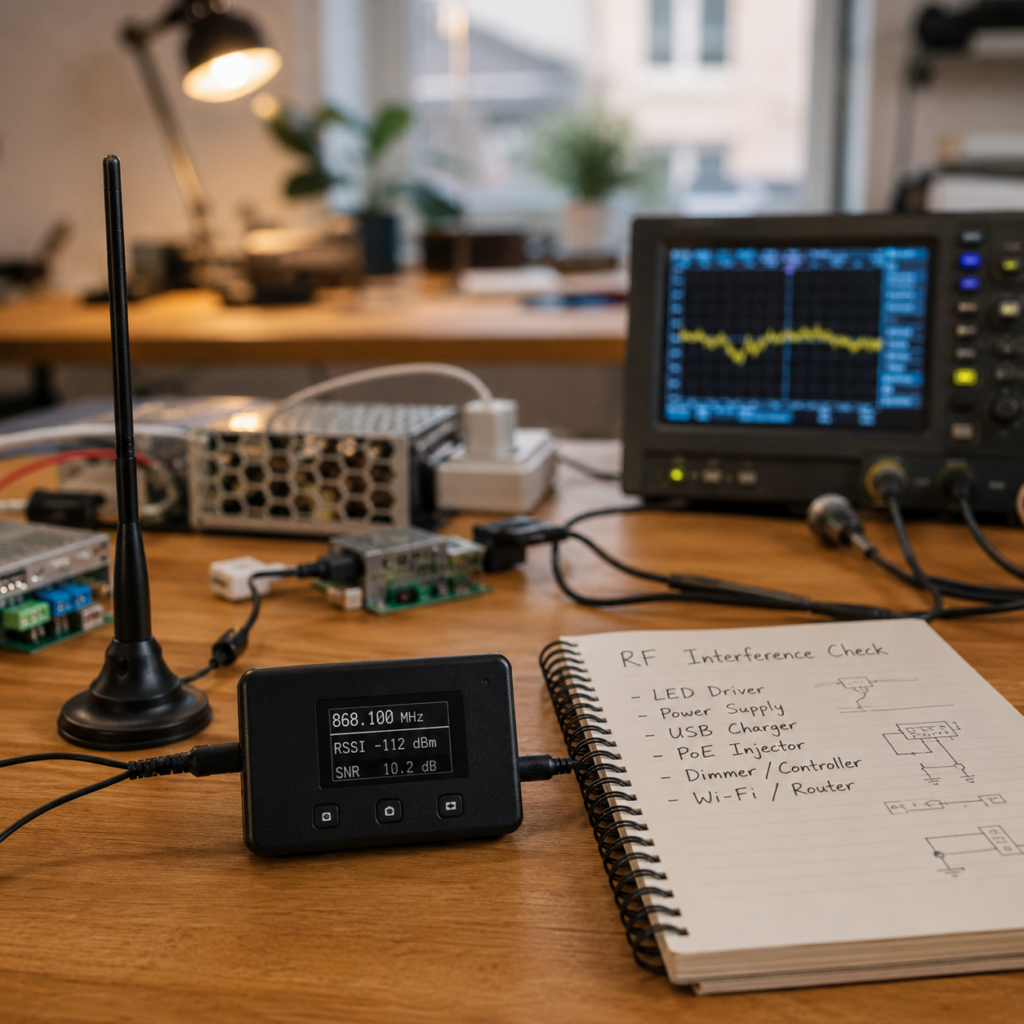
Communication problems are often blamed on distance or weak signals, but local electrical noise is a far more common cause. Switching power supplies, LED drivers, chargers, network equipment, and many other electronic devices can collectively raise the RF noise floor and significantly reduce receiver sensitivity.
Interference does not always originate within the 868 MHz band itself. Strong transmissions in adjacent frequency bands can overload a receiver’s front end or reduce its ability to detect weaker 868 MHz signals, even when those signals are technically outside the operating frequency. A simple analogy is trying to have a conversation next to a noisy construction site: although the construction workers are not part of your conversation, their noise makes it much harder to hear the person standing right in front of you.
This article covers common sources of residential RF interference and provides practical steps to identify and mitigate them.
Typical Symptoms
- Reduced wireless range
- Intermittent connectivity
- Packet loss
- Delayed device responses
- Increased RF noise floor
- Unstable communication
- Problems occurring only at certain times of day
Common Sources of Interference
Power Supplies and Lighting
- LED power supplies
- Switching LED drivers
- LED strip power supplies
- RGB controllers
- Dimmable LED systems
- Low-cost wall adapters
- Smart lighting systems
- Outdoor motion lights
USB and Charging Devices
- USB chargers
- Fast chargers
- Wireless charging stations
- Low-quality phone chargers
Network and IT Equipment
- PoE injectors and PoE switches
- Ethernet switches
- Powerline adapters
- Routers
- USB hubs
Smart Home and RF Devices
- Wireless sensors
- Alarm systems
- Weather stations
- Smart meters
- Wireless thermostats
- Remote control systems
External Sources
- Cellular base stations (receiver overload)
- Solar power inverters
- Wind turbine telemetry systems
- Nearby industrial equipment
- Vehicle detection systems
- Garage door systems
- Neighboring RF equipment
How to Identify the Source
Step 1: Power-Off Test
- Turn off lighting systems.
- Unplug electronic devices where practical.
- Observe whether wireless performance improves.
Step 2: Circuit Isolation
- Switch off one electrical circuit at a time.
- Monitor changes in the RF noise floor or packet reception.
Step 3: Device Isolation
- Reconnect devices one by one.
- Identify which device or combination increases interference.
Keep in mind that several small interference sources are often more problematic than a single faulty device.
Typical Observations
| Observation | Possible Cause |
|---|---|
| Constant broadband noise | Faulty or low-quality switching electronics |
| Raised noise floor | Multiple switching power supplies or nearby RF sources |
| Short periodic bursts | Wireless sensors, telemetry systems, or smart home devices |
| Problems only during certain hours | Timers, lighting, solar inverters, industrial equipment, or neighboring devices |
Mitigation
- Replace low-quality power supplies.
- Minimize unnecessary LED controllers.
- Install ferrite cores on affected cables.
- Increase the distance between antennas and electronic equipment.
- Keep antennas away from power wiring and switching electronics.
- Use quality hardware with good EMC characteristics whenever possible.
Conclusion
Most 868 MHz communication problems are caused by local electromagnetic noise rather than weak radio signals. The interference often originates from everyday electronic devices or from strong transmitters operating in nearby frequency bands. A systematic troubleshooting approach is usually the fastest way to identify the source and restore reliable communication.