Repeaters are an important part of amateur radio. They allow radio stations to communicate over significantly greater distances than would normally be possible with a direct simplex connection. Depending on the repeater, different transmission technologies and operating modes may be available.
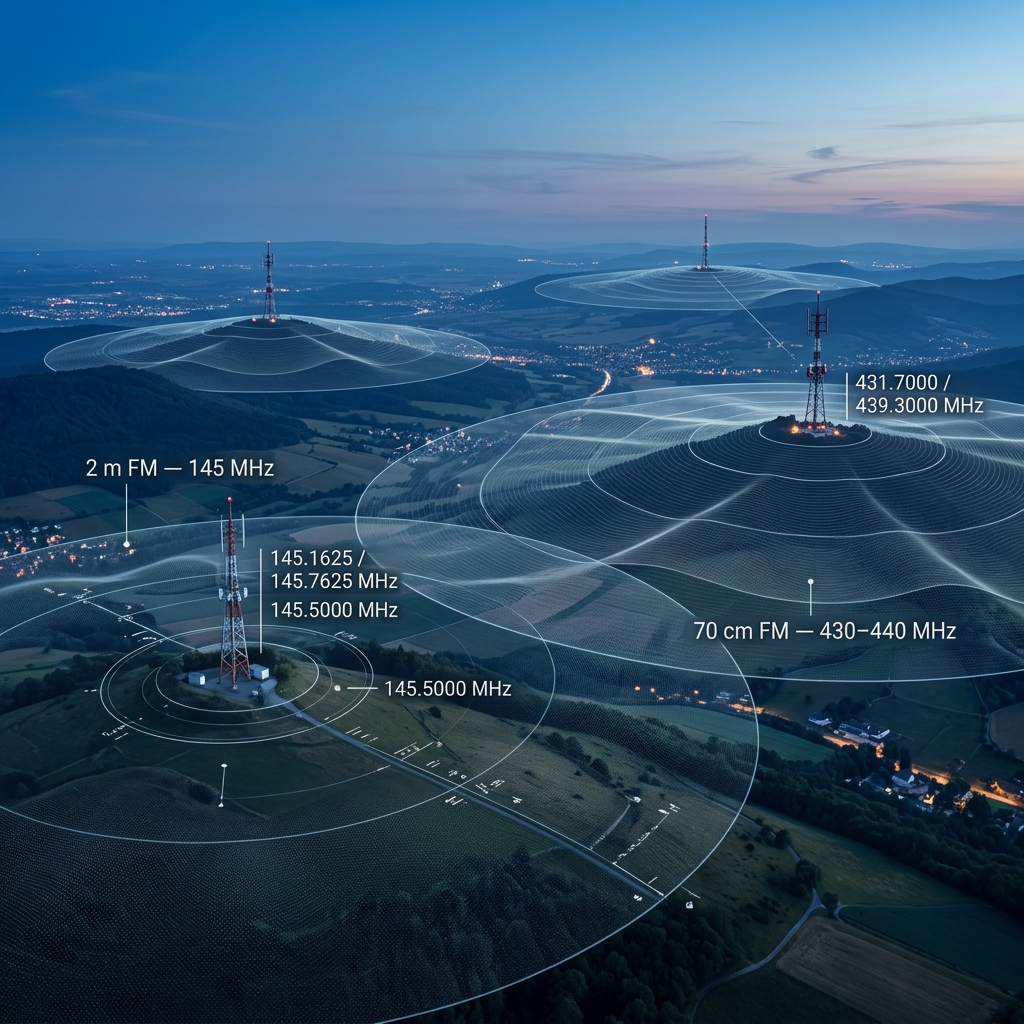
This article explains how to configure repeaters in an amateur radio codeplug. The examples focus on the 2 m and 70 cm bands and on repeaters in and around Mainz, Rhineland-Palatinate, Hesse and the surrounding region.
The regional focus makes the examples practical for local operation, while the configuration principles are generally applicable and can be transferred to repeaters in other regions. This article also serves as my own documentation and reference while building and maintaining my codeplug. Rather than simply collecting a list of frequencies, I want to document the reasoning behind the configuration so that settings remain understandable and can be reviewed or adapted later.
For beginners, repeater configuration can initially appear more complicated than simplex operation because several parameters have to be configured correctly. The most important information is the repeater’s receive and transmit frequencies, the required frequency offset and, depending on the repeater, additional access parameters such as CTCSS, DCS or digital parameters.
The basic principle is straightforward: Your radio receives on the repeater’s output frequency and transmits on the repeater’s input frequency.
Once this principle is understood, the remaining configuration parameters become much easier to understand. The initial focus of this article is on 2 m and 70 cm repeaters.
Repeater Input and Output Frequencies
💡 Remember: When programming a repeater channel, always enter the frequencies from the perspective of the radio, not the repeater.
The repeater’s output frequency is the frequency your radio needs to receive on. Conversely, the repeater’s input frequency is the frequency your radio needs to transmit on. For example, if a 2 m repeater operates with an output frequency of 145.600 MHz and an input frequency of 145.000 MHz, the channel should be configured as follows:
| Radio Setting | Frequency | Description |
|---|---|---|
| Receive Frequency | 145.600 MHz | Repeater output |
| Transmit Frequency | 145.000 MHz | Repeater input |
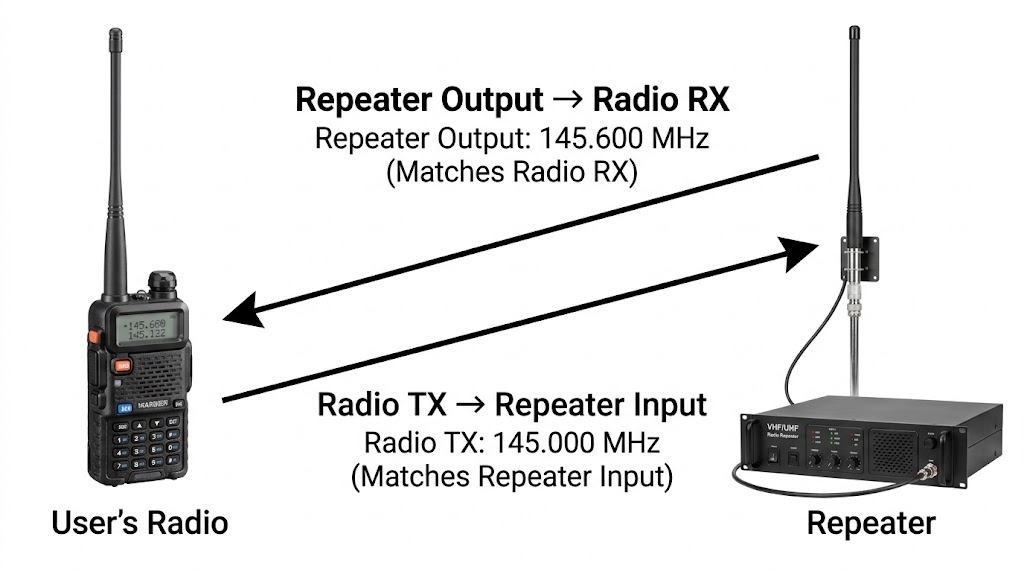
Repeater TX → Radio RX
Repeater RX → Radio TX
The important point is that the terms TX and RX always refer to the device you are configuring. When programming your radio, think from the radio’s perspective.
FM Repeater Channels
Repeaters work differently from simplex channels.
Your radio transmits on the repeater’s input frequency and receives on its output frequency.
For example:
RX: 431.7000 MHz
TX: 439.3000 MHz
This corresponds to a -7.6 MHz offset.
Some repeaters additionally require a CTCSS tone or another access method.
A typical repeater channel therefore contains:
- RX frequency
- TX frequency
- FM mode
- repeater offset
- CTCSS tone, if required
- an appropriate channel name
Recommended Repeater Zone
The following channels are a useful starting point for FM repeaters in the Mainz/Rhine-Main area.
Only repeaters with sufficiently documented parameters are included as fully configured examples.
| Channel | Callsign | Input RX | Output TX | Offset | Access | QTH |
|---|---|---|---|---|---|---|
| ZDF 70 | DB0ZDF | 431.7000 | 439.3000 | -7.6 MHz | CTCSS 67 Hz | Unknown, DE |
| GG 70 GrossGer | DM0GG | 431.2875 | 438.8875 | -7.6 MHz | CTCSS 67 Hz | JN49FV, Gross-Gerau, DE |
| GAZ 70 GrossGer | DB0GAZ | 431.2500 | 438.8500 | -7.6 MHz | Carrier | JN49FV, Gross-Gerau, DE |
| RN 2m Bingen | DB0RN | 145.1625 | 145.7625 | -0.6 MHz | Carrier | JN39XW, Bingen am Rhein, Ockenheim, DE |
| AIS 70 Moerfeldn | DB0AIS | 430.7875 | 438.3875 | -7.6 MHz | CTCSS 67 Hz | JN49GX, Moerfelden-Walldorf, Oberwaldberg, DE |
| VA FM Taunus | DB0VA | 431.7250 | 439.3250 | -7.6 MHz | Carrier | JO40BC, Wiesbaden, Hohe Wurzel, DE |
| GGW 70 Darmstadt | DB0GGW | 431.2000 | 438.8000 | -7.6 MHz | Carrier | JN49HR, Darmstadt, Melibokus, DE |
| VD 2m Darmstadt | DB0VD | 145.0625 | 145.6625 | -0.6 MHz | Carrier | JN49HR, Darmstadt, Melibokus, DE |
| IDS 70 Rosenkopf | DB0IDS | 431.1750 | 438.7750 | -7.6 MHz | 1750 Hz tone * | JO40CF, Idstein, Rosenkopf, DE |
| FT 2m GFeldberg | DB0FT | 145.0000 | 145.6000 | -0.6 MHz | Carrier | JO40FF, Grosser Feldberg, Hessen, DE |
| FT 70 GFeldberg | DB0FT | 430.9750 | 438.5750 | -7.6 MHz | CTCSS 67 Hz | JO40FF, Grosser Feldberg, Hessen, DE |
| HRF 70 GFeldberg | DB0HRF | 431.1500 | 438.7500 | -7.6 MHz | CTCSS 67 Hz | JO40FF, Grosser Feldberg, Hessen, DE |
| MOT 70 KFeldberg | DF0MOT | 431.0250 | 438.6250 | -7.6 MHz | CTCSS 67 Hz | JO40FF, Kleiner Feldberg, Hessen, DE |
| ND 70 Donnersbrg | DB0ND | 431.1250 | 438.7250 | -7.6 MHz | 1750 Hz tone * | JN39XO, Donnerberg, Kirchheimbolanden, DE |
| BKR 70 BadKreuz | DB0BKR | 431.5625 | 439.1625 | -7.6 MHz | Carrier | JN39WT, Bad Kreuznach, Traisen, DE |
The reason is simple: RX CTCSS acts as a gate for your speaker. If the repeater does not transmit 67.0 Hz, your radio keeps the audio muted even though the repeater has been successfully opened. I recently ran into exactly this problem myself. A fellow HAM from my local club helped me identify the cause.
The repeaters listed here are regional examples and are intended to give you an idea of which systems and frequencies are available in the area. They are not a guarantee that you can reach or receive these repeaters from your own location.
Depending on where you are, you may be able to use repeaters that are further away. This can be especially useful when travelling or moving around the region, so it can make sense to include them in your codeplug even if they are not reachable from your home location.
CTCSS
Some FM repeaters require a CTCSS tone to open the repeater. CTCSS is a sub-audible tone transmitted together with the FM signal.
- For example: CTCSS: 67.0 Hz
The tone is normally configured for TX. The repeater uses it to decide whether the transmission should open the repeater.
Do not add a CTCSS tone simply because a repeater uses FM. If the repeater is carrier operated, no CTCSS tone may be required.
Some older repeater systems use a 1750 Hz tone burst to open the repeater instead of CTCSS. This is a different mechanism.
- For example: DB0IDS and DB0ND are listed with 1750 Hz access.
The radio must therefore support and be configured for the appropriate 1750 Hz tone function.
Repeater Information Can Change
Repeater configurations are not necessarily permanent.
A repeater may change:
- frequency
- CTCSS tone
- access method
- operating mode
- network connection
- operating status
Some repeaters may also temporarily or permanently be taken out of service.
Therefore, verify the current parameters before adding a repeater to a permanent codeplug.
Keep FM and DMR Separate
A repeater can support both FM and DMR, but the two modes require different channel configurations. For example, DB0AIS has both an FM and a DMR configuration. The FM channel should therefore be treated as an independent channel from the DMR configuration. This guide intentionally covers analog FM only.
DMR channels require additional parameters such as Color Code, Time Slot, Talk Group and RX Group configuration and should be handled separately.
💭 Tip: Chinese and Japanese manufacturers may not properly support German special characters such as ä, ö, ü or ß. To avoid display errors or unexpected characters, use ae, oe, ue or ss instead.